E-Labeling Regulations in 2026: Why QR Codes Are Not Enough for Global Compliance
2026-05-14

E-labeling is becoming a critical part of global product compliance, especially as QR codes, UDI systems, GS1 Digital Link, and multilingual digital content are increasingly used to connect physical products with online information. However, a QR code on a package does not automatically make a product compliant.
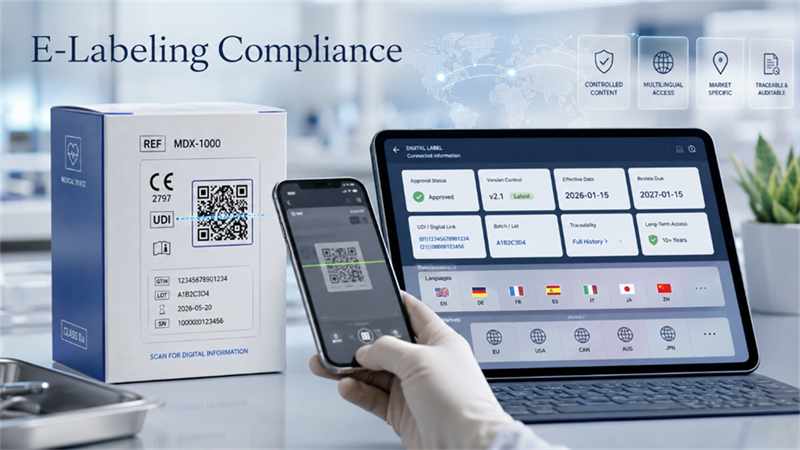
The key regulatory question is not whether users can scan a code. It is whether they can access the correct, approved, market-specific information for the exact product version, batch, language, and user context. This is why e-labeling should be treated as a controlled digital labeling system, not just a packaging design trend.
Key Takeaways
· A QR code is only the access point. It does not prove that the linked content is approved, accurate, current, or compliant.
· E-labeling compliance depends on content control. Companies need approval workflows, version history, language management, and long-term access.
· UDI and GS1 Digital Link are making digital labeling more structured. They help connect product identifiers with regulated product information.
· Multilingual dynamic content is both an opportunity and a risk. It can simplify global packaging, but only when versions, translations, and market-specific requirements are carefully managed.
· Physical labels still matter. Critical safety, identification, and regulatory information may still need to remain on the product or packaging.
E-Labeling at a Glance
Element | What It Does | Compliance Risk |
QR Code | Connects users to digital content | Broken links, wrong content, poor scan quality |
UDI | Identifies regulated medical devices | Mismatch between device ID and linked information |
GS1 Digital Link | Connects product identifiers to web-based data | Poor data structure or inconsistent product records |
Dynamic Content | Delivers different information by market, language, or version | Unapproved updates, wrong language, version confusion |
Physical Label | Provides essential on-pack information | Removing required information too early |
E-Labeling Is Moving From Convenience to Compliance Infrastructure
In its early stages, e-labeling was often viewed as a way to reduce printed materials. Instead of placing a thick instruction manual inside a box, a company could provide a website link, CD, USB drive, or downloadable document. This was especially useful for professional products, industrial equipment, and medical devices used by trained users.
Today, the role of e-labeling is expanding.
Product information is becoming more dynamic. A single product may be sold in dozens of markets, each with different language requirements, regulatory symbols, importer information, warning statements, and documentation rules. Product updates, safety notices, sustainability claims, software versions, and recall information may also change faster than packaging can be redesigned and reprinted.
Printed labels remain essential, especially for critical identification and safety information. But printed space is limited. For small devices, compact packaging, multilingual markets, or products requiring extensive instructions, physical labels alone may no longer provide the best user experience or the most flexible compliance pathway.
This is why e-labeling is increasingly becoming a compliance infrastructure. It connects the physical product to a controlled digital environment where approved information can be accessed, managed, updated, localized, and traced.
The real shift is not from paper to screen. It is from static labeling to controlled digital product information.
Why Regulators Are Becoming More Open to E-Labeling
Regulatory acceptance of e-labeling is growing, particularly where users are trained professionals and where digital access can improve the accuracy, availability, and traceability of product information.
In the European Union, electronic instructions for use have been allowed in certain medical device contexts for years. More recently, the EU updated its eIFU framework through Regulation (EU) 2025/1234, which expanded the possibility of electronic instructions for professional-use medical devices under defined conditions. This reflects a broader regulatory direction: digital information may be accepted when it is reliable, accessible, controlled, and appropriate for the intended user.
In the United States, the FDA's Unique Device Identification system has made standardized device identification a central part of medical device traceability. The FDA's Global Unique Device Identification Database, or GUDID, serves as a reference catalog for devices with a UDI, connecting device identifiers to structured product information.
Outside the medical device sector, standards such as GS1 Digital Link are also reshaping how product data can be connected to the web. GS1 Digital Link provides a standardized way to connect product identifiers, such as GTINs, batch numbers, serial numbers, and expiry dates, to web-based information.
These developments do not mean that paper labeling is disappearing. In many cases, physical labels remain legally required. They also do not mean that every product can replace printed instructions with a QR code.
What they show is a broader direction: regulators and standards bodies are becoming more open to digital access when it improves information control, traceability, user access, and product identification.
The Common Misunderstanding: A QR Code Is Not an E-Labeling System
A QR code is often the most visible part of e-labeling. It is easy to print, easy to scan, and familiar to users. For this reason, many companies begin their e-labeling journey by placing a QR code on a package and linking it to a PDF, landing page, or product manual.
That may be useful, but it is not automatically compliant.
A QR code is only an access point. It does not prove that the content behind it is accurate, approved, current, accessible, or suitable for the target market.
From a compliance perspective, an e-labeling program must answer several questions:
· Which exact product does this QR code represent?
· Does it apply to one model, one batch, one software version, or an entire product family?
· Is the linked content approved by regulatory, quality, and legal teams?
· Can the company prove which version of the content was live at a given time?
· Will an older product batch still lead to the correct historical version of the instructions?
· Are all required languages available for the target market?
· Will the link remain accessible years after the product is sold?
· Is there an alternative for users who cannot access the internet?
· Which information must still appear on the physical label?
If a company cannot answer these questions, the QR code may create more risk than value.
For example, a QR code printed on a medical device package may continue to circulate in the market for years. If the linked web page is overwritten with a newer instruction version that applies only to a later product model, users may receive incorrect information. If the link breaks after a website migration, the digital label becomes inaccessible. If a multilingual page shows the wrong language version for a specific market, the company may fail to meet local labeling expectations.
A QR code can open the door to digital labeling, but it does not prove that the content behind it is compliant.
What Makes E-Labeling Compliant?
A compliant e-labeling system is built on governance, not just technology. Whether accessed through a QR code, DataMatrix, NFC tag, URL, UDI database, or GS1 Digital Link, digital labeling content must be controlled, traceable, accessible, and suitable for the target market and user.
1. Controlled Content
Digital labeling content should follow a formal approval process. Product instructions, safety warnings, compliance statements, technical documents, and multilingual content should not be edited like ordinary web pages.
In regulated industries, updates may need review by quality, regulatory, legal, technical, or clinical teams before publication. Each version should be drafted, approved, published, and archived through a controlled workflow.
2. Version Traceability
Each product model, batch, market, and language version should connect to the correct digital content. Companies should know which version was available at a specific time and which version applies to products already in circulation.
This prevents older products from pointing to incorrect new content after design, software, safety, or regulatory changes.
3. Persistent Access
E-labeling depends on reliable access. Companies should avoid temporary URLs, campaign pages, or file paths that may break during website updates.
Digital labeling pages should remain available, load quickly, work on common devices, and provide clear access to relevant languages and documents. Where required, a paper alternative should still be available.
4. Market-Specific Language
A global product may require different languages, warnings, regulatory symbols, importer details, or local instructions by market. Dynamic content can help direct users to the right language or region-specific page.
However, translations must be approved, version-controlled, and aligned with the physical label. Otherwise, users may receive outdated, incorrect, or mismatched information.
5. Clear Boundaries Between Physical and Digital Labeling
E-labeling does not eliminate physical labels. Product name, manufacturer details, lot number, serial number, expiration date, UDI, safety symbols, warnings, storage conditions, or regulatory marks may still need to appear on the product or packaging.
The goal is not to move everything online, but to decide which information must stay physical and which can be delivered through a controlled digital channel.
UDI and GS1 Digital Link Are Making E-Labeling More Structured
The future of e-labeling will depend less on the visual code itself and more on the data structure behind it.
In medical devices, UDI provides a standardized way to identify devices and support traceability. A UDI can connect a physical product to structured data, regulatory records, and device information systems. This makes e-labeling more reliable because the digital content can be tied to a specific product identity rather than a generic product page.
In broader retail and supply chain environments, GS1 Digital Link is helping transform product codes into web-enabled identifiers. Instead of using a barcode only for checkout or inventory, a 2D code can connect to structured digital information such as product details, batch data, expiry dates, sustainability information, instructions, authentication, or recall notices.
This does not mean every label will look the same. Some products may use QR codes. Others may use GS1 DataMatrix, Data Matrix, NFC, or other digital carriers. The important point is that product identification and product information are becoming more connected.
A label is no longer only a printed surface. It is becoming a bridge between the physical product, the data system, and the user.
Multilingual Dynamic Content Is the Next Compliance Challenge
Dynamic content is one of the most promising features of e-labeling. It allows companies to provide different information based on market, language, user type, product version, or regulatory need.
For global manufacturers, this can reduce packaging complexity. Instead of printing every language on a small package, companies may use a digital access point to provide approved multilingual content. Instead of reprinting packaging every time a non-critical document changes, companies may update approved digital content through a controlled workflow.
However, dynamic content also raises new compliance risks.
If content changes too easily, companies may lose control over approved labeling. If language versions are not synchronized, one market may receive outdated information. If regional routing is inaccurate, users may see content intended for another jurisdiction. If a product page is updated without linking the change to product version or batch data, old products may point to new instructions that do not apply.
This is why e-labeling requires content governance. Companies need clear ownership, approval workflows, translation control, version records, release dates, and archiving. They also need to test the user journey: what happens when a user scans the code in a hospital, warehouse, retail store, factory, or home environment?
Dynamic labeling can reduce packaging complexity, but only if companies manage language, version, and approval control with regulatory discipline.
Practical Implications for Brands, Manufacturers and Labeling Teams
For companies planning to implement e-labeling, the first step should not be choosing a QR code generator. The first step should be defining the compliance model.
Brands and manufacturers should begin by identifying which information must remain on the physical label and which information can be delivered digitally. They should then map products, markets, languages, versions, and user groups before building the digital content structure.
Labeling teams should also work closely with packaging and printing partners. The code must be readable, durable, correctly sized, and placed where users can find it. Print contrast, surface material, curvature, abrasion, moisture, sterilization, and lighting conditions can all affect scan performance.
For regulated products, readability is not only a user-experience issue. If users cannot scan the code reliably, they may not be able to access required information.
Companies should also connect e-labeling with product master data, batch records, UDI data, or GS1 identifiers where applicable. This reduces the risk of linking users to generic or incorrect content.
The most practical rule is simple: do not treat QR codes as a legal shortcut. Treat them as part of a controlled labeling system.
Conclusion: E-Labeling Is a Compliance System, Not a QR Code Trend
E-labeling is becoming more important as product information becomes more complex, global, multilingual, and time-sensitive. Regulators and standards bodies are increasingly open to digital access when it supports traceability, usability, and controlled information delivery.
But e-labeling compliance is not achieved by printing a QR code on a package.
A compliant e-labeling system requires approved content, version control, persistent access, market-specific language management, and a clear understanding of what must remain on the physical label. UDI, GS1 Digital Link, 2D barcodes, and dynamic multilingual content can all support this transformation, but only when they are part of a governed product information system.
In the next stage of product labeling, compliance will not be defined only by what is printed on the package. It will also depend on how reliably that package connects users to the right digital information.